The Official Website of the Hempstead County Economic Development Corporation
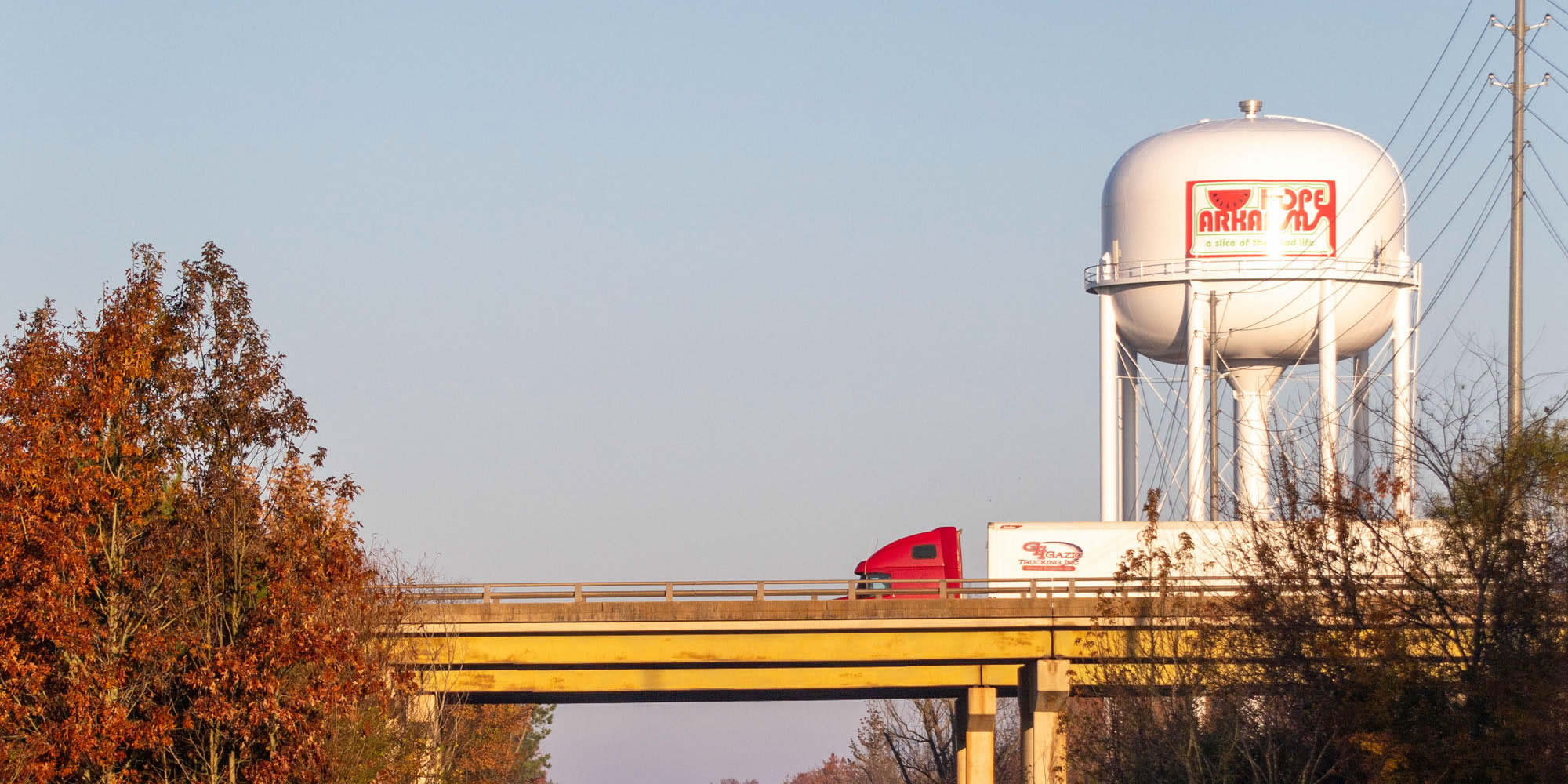
♦Located halfway between Dallas and Memphis on Interstate 30, Hope, Arkansas is a world-class southern community in the Texarkana metropolitan area. Impressive business advantages and a quality family-oriented lifestyle have made Hope one of the top jobs-growth communities in the entire 4-state region. ♦To believe in a place called Hope, is to believe in progress, growth, diversification, success, deep-rooted values, and hard-working people. ♦We invite you to learn more about the great business climate, memorable attractions, and healthy living environment in the beautiful city of Hope. Come share our pride!
Hempstead County Economic Development Corporation 23rd Annual Appreciation Luncheon - June 10, 2009
Lt. Governor Bill Halter and AR State Representative David "Bubba" Powers
Halter : No 'Thank god for Miss,"
By Ken McLemore
GateHouse News Service
Thu Jun 11, 2009, 04:41 PM CDT
Hope, Ark. -
“For me, first, middle, and last, this has not been about the lottery; but, about education,” Halter said.
Taking an almost revivalist tone with a generally receptive audience, Halter reminded the 200 or so attendees in the University of Arkansas Community College at Hope Purtle Meeting Rooms that UACCH will benefit directly from the overwhelming passage of the lottery amendment. Halter said that Arkansas has for decades had a 48th-49th in the nation mentality.
“It’s demoralizing; it sets low expectations; it diminishes hope,” he said. “If you look at the economic history of every city, state, region or country, that, short of discovering oil or natural gas underneath your feet, the only sustained long-term way you can drive income growth in any state, city, region or country, is through the power of educating the workforce.”
He related the story of a public speech he gave during the campaign where a man in the audience rebuked Halter’s assertion that Arkansas has remained 48th-49th in economic and educational benchmarks throughout the lifetime of practically everyone in the room.
“All my life, and for the life of every person in this room, Arkansas has been either 48th or 49th in per capita income out of the 50 states,” he said. “As soon as I said that Arkansas had been 48th or 49th in per capita income for the life of every Arkansan, a hand shot up in the back. “He said, ‘Governor Halter, that’s not true,’” Halter added. “I looked at him and said, ‘Tell me what you mean.’ And, he said, ‘In my lifetime, we’ve been 47th.’ I looked at him and said, ‘Well, tell me what you mean.’ And, he said, ‘Well, I’m 83 years old, and before Alaska and Hawaii were admitted to the Union, we were 47th.’”
Halter said that parents recognize that they will “do anything” for their children; but, what does that mean? “But, sometime between the birth of those kids and the time they get to high school, something happens to too many of them; something happens along the way,” he said. “Those parents come to realize that their income levels are not going to be sufficient to afford a higher education for their kids.”
Halter argued that the passage of the lottery amendment to fund higher education scholarships will change that. “Arkansas will be the first and the only state to devote every dime to state scholarships,” he said. Beginning in 2010, Halter said every high school graduate in Arkansas who maintains a 2.5 grade point average or scores 19 or higher on the ACT or an equivalent test, will be eligible to receive a scholarship to any public or private college or university in Arkansas.
“You get a scholarship; it’s just that simple,” Halter said. He said enabling legislation passed this year will set the funding levels at $5,000 per year at four year institutions and $2,500 per year at two-year institutions.
“For those of you familiar with our public higher education, that is virtually full tuition,” Halter said. He said that within five years 30,000-35,000 Arkansans will benefit from the lottery-funded scholarships.
“There is no more appropriate place to tell about this than at the University of Arkansas Community College at Hope,” Halter said. “No lieutenant governor will ever again come to Hope, Arkansas, or any other community in the state and have to talk about the fact that for their entire life, and the lives of other Arkansans, we have been 48th or 49th.” New member investors of the Hempstead County Economic Development Corp. recognized Wednesday included Kent Hendrix, McLarty Auto Group, Mike Purtle Construction, Rainbow of Challenges, and Red Carpet Employment Agency.
HCEDC Appreciation Ad
Farmer's Market News 2009
Farmer's Market Flyer
John W. Turk, Jr. Power Plant
11/5/2008 SWEPCO receives ADEQ air permit for Turk Power Plant
SHREVEPORT, La., November 5, 2008 – AEP Southwestern Electric Power Company (SWEPCO), a unit of American Electric Power (NYSE: AEP), received its air permit today for the John W. Turk, Jr. Power Plant from the Arkansas Department of Environmental Quality (ADEQ). The air permit regulates the plant’s main steam generating unit, consisting of one coal boiler, and other emission sources at the plant. The boiler powers a single steam turbine with an output of 600 megawatts. The Turk Power Plant, to be built in Hempstead County, Ark., will utilize low-sulfur coal and state-of-the art emission control technologies, including a design that allows for the retrofit of carbon dioxide controls. The emission control technology being installed will enable the Turk Plant to meet emission limits that are among the most stringent ever permitted for a pulverized coal unit.
“We are extremely pleased to receive the ADEQ air permit for the Turk Plant, which will be one of the cleanest coal plants ever built,” said Michael G. Morris, AEP chairman, president and chief executive officer. “The Turk facility represents the most affordable choice to meet the future energy needs of SWEPCO’s customers and it’s good for the local economy.” Plant construction, expected to take about 48 months, will begin immediately, and will create about 1,400 jobs at the height of the project, now slated for completion in late 2012. The construction will generate about $38 million in sales and property tax revenues, and upon completion, will bring 110 permanent jobs with an annual payroll of around $9 million to the southwest corner of Arkansas near Hope.
“We thank the many community leaders, elected officials, business organizations, labor union representatives and customers who have supported SWEPCO in this important process through two air permit public hearings,” said Paul Chodak, SWEPCO president and chief operating officer. “Your voices were heard by the ADEQ, and they made a good decision that will bring reliable, affordable electricity in the years ahead to the customers and communities we serve.”
The Arkansas Public Service Commission, the Louisiana Public Service Commission and the Public Utility Commission of Texas have approved SWEPCO’s request to build the Turk Plant. Since early 2008, workers have been performing site development work and receiving equipment and materials at the plant’s location between Fulton and McNab, Ark. With the approval of the air permit, SWEPCO has authorized its contractor to begin construction of the power generating facilities.
The plant will burn sub-bituminous low-sulfur coal and convert the energy using ultra-supercritical technology, which operates at higher temperatures, to improve efficiency and thus reduce emissions. While ultra-supercritical plants are in service in Europe and Asia, Turk will be one of the first plants with these advanced steam temperatures to go into commercial operation in the U.S. The baseload coal-fueled Turk Plant is part of SWEPCO’s plans, previously announced in 2006, to construct facilities to meet the short-term peaking, intermediate and long-term energy needs of its customers. The company has completed the 340-megawatt Harry D. Mattison natural gas-fueled peaking plant at Tontitown in Northwest Arkansas. SWEPCO also is building the 500-megawatt, combined-cycle natural gas-fueled J. Lamar Stall Unit for intermediate load needs at its existing Arsenal Hill Power Plant in Shreveport.
“Coal is essential to meeting the growing energy needs of our region and our country, and we will put new technology to work at Turk that will generate electricity more efficiently with less environmental impact,” said Chodak.
SWEPCO serves more than 473,500 customers in three states, including 113,500 in western Arkansas, 180,000 in Northwest Louisiana, and 180,000 in East and North Texas. SWEPCO’s headquarters are in Shreveport, La. News releases and other information about SWEPCO can be found at www.swepco.com.
American Electric Power is one of the largest electric utilities in the United States, delivering electricity to more than 5 million customers in 11 states. AEP ranks among the nation’s largest generators of electricity, owning nearly 38,000 megawatts of generating capacity in the U.S. AEP also owns the nation’s largest electricity transmission system, a nearly 39,000-mile network that includes more 765 kilovolt extra-high voltage transmission lines than all other U.S. transmission systems combined. AEP’s transmission system directly or indirectly serves about 10 percent of the electricity demand in the Eastern Interconnection, the interconnected transmission system that covers 38 eastern and central U.S. states and eastern Canada, and approximately 11 percent of the electricity demand in ERCOT, the transmission system that covers much of Texas. AEP’s utility units operate as AEP Ohio, AEP Texas, Appalachian Power (in Virginia and West Virginia), AEP Appalachian Power (in Tennessee), Indiana Michigan Power, Kentucky Power, Public Service Company of Oklahoma, and Southwestern Electric Power Company (in Arkansas, Louisiana and east and north Texas). AEP’s headquarters are in Columbus, Ohio. News releases and other information about AEP can be found at www.aep.com.
This report made by AEP and its Registrant Subsidiaries contains forward-looking statements within the meaning of Section 21E of the Securities Exchange Act of 1934. Although AEP and each of its Registrant Subsidiaries believe that their expectations are based on reasonable assumptions, any such statements may be influenced by factors that could cause actual outcomes and results to be materially different from those projected. Among the factors that could cause actual results to differ materially from those in the forward-looking statements are: electric load and customer growth; weather conditions, including storms; available sources and costs of, and transportation for, fuels and the creditworthiness and performance of fuel suppliers and transporters; availability of generating capacity and the performance of AEP’s generating plants; AEP’s ability to recover regulatory assets and stranded costs in connection with deregulation; AEP’s ability to recover increases in fuel and other energy costs through regulated or competitive electric rates; AEP’s ability to build or acquire generating capacity (including AEP’s ability to obtain any necessary regulatory approvals and permits) when needed at acceptable prices and terms and to recover those costs through applicable rate cases or competitive rates; new legislation, litigation and government regulation including requirements for reduced emissions of sulfur, nitrogen, mercury, carbon, soot or particulate matter and other substances; new legislation, litigation and government regulation including requirements for reduced emissions of sulfur, nitrogen, mercury, carbon, soot or particulate matter and other substances; timing and resolution of pending and future rate cases, negotiations and other regulatory decisions (including rate or other recovery for new investments, transmission service and environmental compliance); resolution of litigation (including pending Clean Air Act enforcement actions and disputes arising from the bankruptcy of Enron Corp. and related matters); AEP’s ability to constrain operation and maintenance costs; the economic climate and growth in AEP’s service territory and changes in market demand and demographic patterns; inflationary and interest rate trends; AEP’s ability to develop and execute a strategy based on a view regarding prices of electricity, natural gas and other energy-related commodities; changes in the creditworthiness of the counterparties with whom AEP has contractual arrangements, including participants in the energy trading market; actions of rating agencies, including changes in the ratings of debt; volatility and changes in markets for electricity, natural gas and other energy-related commodities; changes in utility regulation, including the potential for new legislation in Ohio and membership in and integration into regional transmission organizations; accounting pronouncements periodically issued by accounting standard-setting bodies; the performance of AEP’s pension and other postretirement benefit plans; prices for power that AEP generates and sells at wholesale; changes in technology, particularly with respect to new, developing or alternative sources of generation; other risks and unforeseen events, including wars, the effects of terrorism (including increased security costs), embargoes and other catastrophic events.
MEDIA CONTACTS: SWEPCO Corporate Communications: Scott McCloud, 318-673-3532 Kacee Kirschvink, 318-673-3394
AEP Corporate Communications: Pat Hemlepp, 614-716-1620
HOPE, AR – The University of Arkansas Community College at Hope is excited to announce that it has officially set a new enrollment record for the institution.After completing the enrollment census January 27, UACCH’s official enrollment for the Spring 2009 Semester is 1336.
Chris Thomason, Chancellor of UACCH said, “This is a great day for UACCH and Southwest Arkansas.This enrollment sets a new record for UACCH, but more importantly symbolizes the change we are able to make in the future of our community and region by increasing the number of citizens with higher educations.Record enrollment gives us the opportunity to have record graduation numbers in future.I appreciate every student who has enrolled this semester and commit to them that the UACCH family will do all we can to insure they successfully achieve their educational goals.These students work hard to over come many obstacles that attempt to restrict their pursuit to further their education.UACCH will demonstrate the same dedication in being a partner in our students’ educational growth.I also want to thank the UACCH faculty, staff and community supporters who continue to work hard to maintain student success as our core focus.”
The record enrollment was previously set in the Fall of 1998 with 1327 students enrolled.In the Fall of 2007 UACCH came close to this record with an enrollment of 1309.Since 1998 spring semester enrollment has not been as strong as fall enrollment, but that trend has been broken with this semester’s enrollment.This is the first spring enrollment in the history of UACCH to exceed the 1300.
For more information about UACCH, visit our website at www.uacch.edu.
Pictured above, Chris Thomason, Chancellor of UACCH observes as Peggy Comer, General Manager of CMC Joist and Deck signs the MOU that outlines the details of the partnership.
UACCH signs Memorandum of Understanding with CMC Joist and Deck to purchase SimWelder System for welding training.Pictured at left, Chris Thomason, Chancellor of UACCH observes as Peggy Comer, General Manager of CMC Joist and Deck signs the MOU that outlines the details of the partnership.CMC Joist and Deck donated $20,000.00 towards the purchase of this innovative teaching aid.